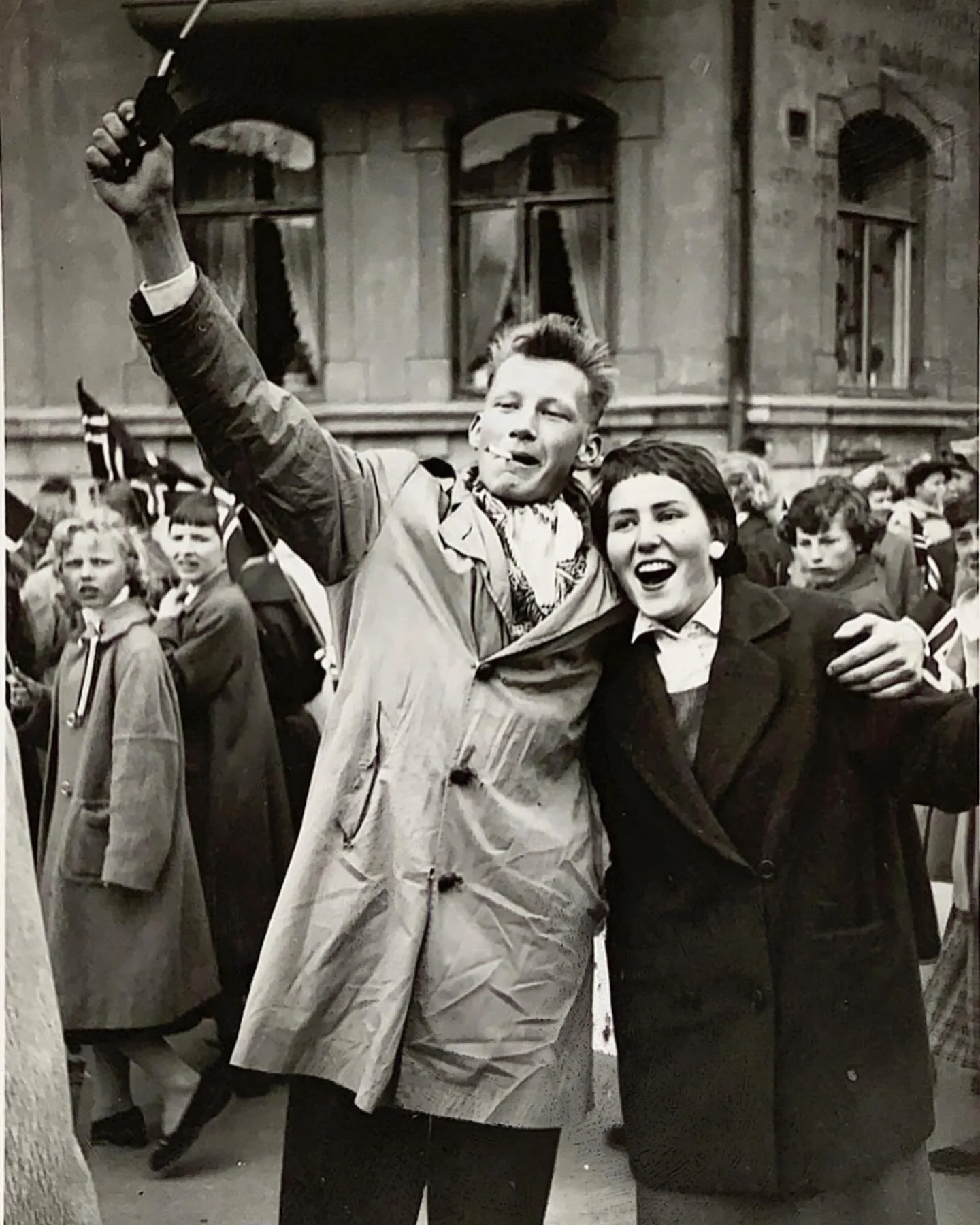
Ingrid Fiksdahl King (b. 1937, Trondheim, Norway) was a Norwegian-born painter and architect whose work bridges the disciplines of visual art and environmental design. Raised in a household shaped by practical craftsmanship—her father a self-taught draftsman and woodcarver—King developed an early sensitivity to form, material, and the expressive potential of line. Her childhood, marked by the upheaval of World War II in occupied Norway, left a lasting awareness of the fragility and resilience of both bodies and built environments.
King pursued her formal education in architecture at the University of California, Berkeley, where she received her professional degree in 1965. During her time there, she began a long and influential collaboration with Christopher Alexander at the Center for Environmental Structure. As a co-author of A Pattern Language and related publications, she contributed to a groundbreaking framework for understanding how spatial systems shape human experience—an intellectual foundation that reflected her investigations through her painting practice.
Alongside her architectural career, which included teaching positions at Berkeley and later as a professor at the Norwegian University of Science and Technology (NTNU) in Trondheim, King maintained a sustained and evolving commitment to painting. Working between Norway and California, she developed a body of work grounded in drawing and informed by close observation of the both the landscape and the human figure in motion. Her goal was to “catch” a moment of movement. King’s compositions often begin with linear structures—what she described as a “scaffold”—that expand into layered fields of color, where figure and space become intertwined.
King’s paintings reflect a lifelong engagement with questions central to both architecture and art: how bodies inhabit space, how movement can be structured, and how perception is shaped through form. While her work resonates with the legacy of Abstract Expressionism, it is distinguished by its architectural sensibility and its insistence on painting as an embodied experience. Across her canvases, structure and gesture, drawing and color, operate in tension—producing compositions that are at once rigorously constructed and dynamically alive.
Throughout her life, King’s practice remained deeply interdisciplinary, extending theoretical concerns into material form. Her work stands as a unique contribution to late twentieth- and early twenty-first-century painting, offering a vision of the canvas not merely as a surface, but as a space to be inhabited—where visual rhythm and bodily perception converge.
Her professional papers and archival materials are held at the College of Environmental Design Archives at the University of California, Berkeley.